Tampilkan postingan dengan label Foundling Museum. Tampilkan semua postingan

The Foundling Hospital: A Child's View

 
A mother leaving her baby at the Foundling Hospital, Paris.
Original canvas can be seen at the Foundling Museum, London.
My previous two posts looked at the Foundling Hospital, London, and how it looks today, and also an exhibition of tokens on display at what is now the Foundling Museum. But if, as a Georgian child, you were taken in by the hospital, what sort of upbringing could you expect?

Once admitted each child was given a new name. At first the hospital's governors lent their own names, but this turned out to be confusing for some children who held false hopes of illustrious parentage. 
Gin Lane by the 18th century artist, William Hogarth -
a perilous time to be a child.
The babies were breast fed and their first two to four years of life were likely spent in the countryside, farmed out to a wet nurse. At around about three years, they returned to London where they were inoculated against smallpox - a major innovation of the day. It seems an emphasis was placed on healthy living because they were encouraged to play outside.
"Exercised in the open air …as may contribute to their health and induce a habit of active hardiness."
The Foundling Hospital offered a better future than that of
an abandoned child living on the streets
However, even play was done with an eye to future work. For instance boys played with bats and balls.... and javelins because they might help them find a job!
"Inure them for a proper slight in the throwing a harpoon in the Greenland [whale] fishery."

Boys stayed in education for longer than girls, who at the age of six took on housekeeping duties around the hospital in order to make them:
"Useful servants to such proper persons as may apply for them."

Boys faired a little better  in terms of having a longer childhood, but at the age of twelve were often sent out into the world:
"At twelve years the boys be sent to sea or husbandry[agricultural labour] …to have in readiness boys instructed in gardening for such persons as may incline to take them into their service."
 
Foundling children during a church service.
The original painting is on display at the Foundling Museum, London
Whilst at the hospital the children wore a uniform designed by the Georgian artist, William Hogarth, who was a patron of the society. The girls wore brown serge dresses with a stiffened bodice but no stays, and the boys wore jackets and breeches, cheered by touches of red.

The food was: "plain and simple…their bread coarse and their drink water."Bread was made on the premises, perhaps making it more healthy than the adulterated and contaminated fair available in the city. However, the understanding of the nutritional needs of children was almost none existent and despite the governors best intentions, many of their wards suffered from scurvy or rickets.
 
Thomas Coram established the Foundling Hospital in the 18th century,
and his work for the welfare of children continues in his name today.
Despite everything, a child raised by the Foundling hospital had a better start in life than many poor children: well trained, presentable and immune to smallpox - they stood a good chance of finding employment. The only downside was the hospital's finite resources. It's a telling and sad fact that in July 1749, out of 83 applications for mercy, only 20 babies were taken in.

If you have found this post interesting you may want to read:
London Then and Now: The Foundling Hospital
The Foundling Hospital: Fate, Hope and Charity

The statue of Thomas Coram, erected in his honour
outside the Foundling Museum

London Then and Now: The Foundling Hospital

The Foundling Hospital -
The word 'hospital' was used in a wider sense than today,
to indicate 'hospitality'.
Those of you who follow my blog will know I like to visit historic sites and compare the appearance of the environs with how it looked in the past. I find this fascinating because a historic building may be perfectly preserved but English Heritage or the Historic Royal Palaces have no control on what goes around it.
This weekend I revisited one of my favourite places, the Foundling Museum, to see an exhibition of tokens (I digress...more in a future post) and on a beautiful sunny day I took a walk around the environs of Brunswick Square to compare 'then and now'.
A scene depicting a queue of children hoping to be admitted to the Foundling Hospital.
Note the rural setting and open countryside.
 
In 1761 a 56 acre site was purchased in Bloomsbury, London, on which to build the Foundling Hospital. The building was completed in 1752 and general reception of children started in 1756. Bloomsbury was chose since it was on the edge of London and opened onto fields and was therefore beneficial to the health of the foundling children.

This print of the Foundling Hospital (18th century) is notable for the open
space around it.
 
In the modern day, the noise and bustle of London presses in from all sides, but despite some horrendous architecture some precious patches of green space remain. Directly opposite the Foundling Museum (alas, not the original building) is Brunswick Square.

Foundling Museum (central building) as seen from the
far side of Brunswick Square (behind me is a road)
Although the original building no longer exists, a replacement was built in keeping with the character of the first.
The Foundling Museum - now home to a collection of works of art,
including those by William Hogarth, an 18th century patron.
However, not all neighbouring buildings are so sympathetically designed - take for instance the immediate neighbour (imagine the above photo extending to the left of the tree)

The London School of Pharmacy - adjacent to the Foundling Museum
Just emerging to the left of the London School of Pharmacy, on the other side of the square, is another modern building - a student hall of residence.

The west side of Brunswick Square.
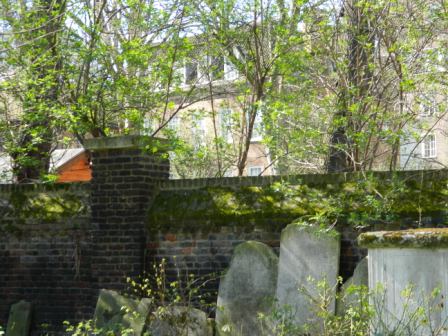
So what about to the rear of the Foundling Museum? I found a delightful patch of green that was once a cemetary, St George's Gardens.

Over the wall and through the trees, is the back of the
Foundling Museum
However, this once peaceful space is even now being hemmed in
by redevelopement.
And as I turned to leave St George's Garden, what did I see but the Post Office Tower (or whatever they call it these days!) A reminder how small London is and how close everything is together.
The Post Office Tower.
Next week: more about the history of foundlings and the hospital.

Unofficial London: Gin Lane


As an avid reader of historical romance novels, one of my favourite authors is Elizabeth Hoyt and her 'Maiden Lane' books. Set in the Georgian period the series is based around an orphanage in the notorious St Giles district of London. This was a district known for its squalor and poverty, a place where criminals thrived and gin-selling flourished. The Georgian artist William Hogarth created 'Gin Lane' as a piece of social comment on the squalor and lawlessness of St Giles, and after reading Ms Hoyt's books, I looked at the etching with fresh eyes.
 

 The focal point of the picture is the half-naked woman in the foreground. In a drunken stupor she is careless of her baby, who falls from her arms into the cellar of the neighbouring gin shop (note the jug-shaped shop sign - to alert those who couldn't read as to where they could purchase alcohol) The woman is shown with sores on her legs, probably syphilitic ulcers, the implication being that she is a prostitute.

Sadly, this scene is not as outlandish as it might appear. Records exist of a woman, Judith Dufour, who reclaimed her child from the workhouse and then strangled it, in order to sell the child's clothes (for 1s. 4d.) in order to buy more gin.

In Hogarth's painting, languishing in front of the disreputable mother is a skeletal pamphlet-seller. He rests with his eyes closed, glass in hand (from which he drank gin?) whilst a leaflet titled "The Downfall of Mrs Gin," moralising about the evils of alcohol, spills from his basket.


To the left of the picture is Mr Gripe's pawnbrokers shop. He is buying a carpenter's tools and a housewife her cooking pots, supplying them with money to buy their next drink.
If you look carefully, in the top right hand corner of the painting is a barber, who has hung himself because no one has the money for a shave. Apart from gin-sellers and pawnbrokers, the only other business to survive is the undertaker (again, note the coffin-shop sign) kept busy by gin-related deaths.
The Foundling Hospital, as it is today - a museum.
Intriguingly, the artist Hogarth worked with a philanthropist called Thomas Coram who established the Foundling Hospitalin London. Going back to Ms Hoyt's 'Maiden Lane' books, these also feature a charitable orphanage and this link made me wonder if original the inspiration behind Ms Hoyt's Maiden Lane series, came from seeing Hogarth's work and reading his support for orphans and foundlings.

Have any of you read the Maiden Lane books? Which is your favourite?

 
Older Post ►
 

Copyright 2011 HISTORY, ROMANCE AND...CATS is proudly powered by blogger.com